How Three.js maintainers started writing documentation for AI agents
The 3D library has shipped instructions for language models since February, and its latest release credits Claude as co-author of 65 changes.

Summary

On March 24, Ricardo Cabello, who created Three.js, a JavaScript library for drawing 3D graphics in web browsers, and posts as mrdoob, wrote on X that he had “Ported Kenney’s Starter Kit Racing to @threejs.” He had also built a basic track editor, and a second post linked the playable game: “Build a track and share the link!”
Cabello had help. The repository for the port says it was “Ported to JavaScript with Claude,” Anthropic’s model, and 44 of its 47 commits name a Claude model as co-author. Florian Isikci, a solo developer who runs the site dmnshd.gg, wrote in a May 19 post that he forked it the same day and shipped virtual- and augmented-reality support the next morning, as “a wave of developers forked it and piled features on.”
Nearly eight months on, the same pattern runs through the library itself. In the week of November 7 to 13 the three package, as Three.js is listed on npm, the main registry for JavaScript code, was downloaded 36,148,534 times, npm’s public counts show, about 12.5 times the same week of 2025. Those counts cannot say how much of the rise comes from coding agents, AI systems that write and run code for a developer. The repository shows more. Since February it has carried instructions addressed to language models, and its October 30 release credits Claude on 65 changes. Agents have become both readers of Three.js and contributors to it, and the people who build the library now write for them.
Three.js downloads rose twelvefold in a year
The growth came in two stages. In the week of August 2 to 8, 2020, three had 227,473 downloads, and in the matching week of 2025 it had 2,194,558, a rise of about tenfold in five years. Then the curve bent. October 2026 brought 102.5 million downloads, about eight times the October 2025 total, and most of that increase came after January.
Three.js downloads rose about eightfold in the year to October 2026
Monthly npm downloads of the three package, millions
Data
| Label | three |
|---|---|
| Jan 2024 | 5.2M |
| Feb 2024 | 5.6M |
| Mar 2024 | 5.3M |
| Apr 2024 | 5.1M |
| May 2024 | 5.6M |
| Jun 2024 | 5.3M |
| Jul 2024 | 5.8M |
| Aug 2024 | 5.6M |
| Sep 2024 | 5.8M |
| Oct 2024 | 6.5M |
| Nov 2024 | 6.3M |
| Dec 2024 | 5.5M |
| Jan 2025 | 6.6M |
| Feb 2025 | 7M |
| Mar 2025 | 7.5M |
| Apr 2025 | 8.1M |
| May 2025 | 7.9M |
| Jun 2025 | 8.3M |
| Jul 2025 | 9.4M |
| Aug 2025 | 10M |
| Sep 2025 | 11M |
| Oct 2025 | 12.6M |
| Nov 2025 | 12.3M |
| Dec 2025 | 13M |
| Jan 2026 | 17.1M |
| Feb 2026 | 23.4M |
| Mar 2026 | 35.8M |
| Apr 2026 | 37M |
| May 2026 | 38.8M |
| Jun 2026 | 49.4M |
| Jul 2026 | 57.3M |
| Aug 2026 | 63.2M |
| Sep 2026 | 72.9M |
| Oct 2026 | 103M |
André Baltazar, a developer building a game on Three.js, drew attention to the summer figures in a post on August 9, when a week’s downloads stood at 14,134,422. “Just over two million per day,” he wrote. By mid-November the weekly figure was about two and a half times that.
Rival browser 3D libraries rose over the same year from far smaller bases. Downloads of @babylonjs/core, the main package of Babylon.js, grew about 3.6-fold, and those of PlayCanvas, another browser 3D engine, about 22-fold, to 192,653 in the week of November 7 to 13. Three.js still drew about 96 times the downloads of Babylon.js that week.
Agents reach for a library whose output they can see
Developers who work with the library give a mechanical reason for the fit. In Baltazar’s account, Three.js hands a model scenes, cameras, materials and renderers in plain JavaScript, backed by years of small examples showing how each part works. A model, he wrote, “can create a scene, run the page, read the browser error, change the code and try again.”
Because the output is a picture, an agent can also take a screenshot and catch its own mistakes, such as a camera placed inside the floor or a car facing backwards, errors that by Baltazar’s account still happen quite often. The finished game is a link that someone can open seconds later without installing an engine or a launcher.
His evidence that agents pick Three.js comes from his own feed on X, where most of the agent-made 3D games he sees “begin by installing the same package.” It is one developer’s observation. He expects the effect to compound, writing that future coding models will have much more Three.js material to learn from than earlier ones did.
The AI-coding community made the choice explicit earlier. Andrej Karpathy, a co-founder of OpenAI, coined “vibe coding,” describing what you want and letting a model write the code, on February 2, 2025. That year’s Vibe Coding Game Jam, run by the developer Pieter Levels, required entries to be at least 80% AI-written and recommended three.js in its rules, according to an account by Utsubo, an interactive creative studio that works with Three.js. It drew more than 1,000 entries, and Cabello and Karpathy were among the judges.
npm counts every package fetch as a download
The download figures are softer than they look. The documentation of humanloads, a free tool that estimates how many installs of an npm package are real, states the problem: “npm’s download counter counts every tarball fetch, not every person,” meaning every fetch of a package’s compressed archive. Registry mirrors, security scanners, crawlers and CI pipelines, the automated systems that build and test code on every change, all add to the number. For a big package, it says, the count is “mostly CI, builds and dependency installs that no public data can separate from people.”
Baltazar raised the same objection to his own numbers. Fourteen million downloads, he wrote, do not mean fourteen million games, because the figure includes automated installs, CI and people repeatedly creating projects they never open again. He still thinks AI is responsible for a large part of the recent growth, since the timing matches what he sees every day, but he stops short of a share: “I don’t know how much of the jump from 227,000 weekly downloads to fourteen million belongs to AI.”
The longer series supports two readings. Three.js was on a steep curve before the practice had a name: monthly downloads rose from about 1.0 million in August 2020 to 5.6 million in August 2024, half a year before Karpathy’s post. The parallel rise of Babylon.js and PlayCanvas in 2026 is consistent with a cause that reaches beyond one library, whether that is agents generating 3D projects of every kind or a general increase in automated installs.
Package dependencies blur the count as well. React Three Fiber, which lets developers use Three.js inside the React web framework, had 9,179,288 downloads in the week of November 7 to 13, and because it depends on three, its installs and three’s overlap. Utsubo attached a caveat to its own comparison of the libraries, writing that download counts include CI and repeat installs, “so read them as a measure of ecosystem size, not of live sites.” npm’s public counts give a total per package and per day and nothing about who or what made each request.
Models read the project’s docs and sign its commits
Inside the project, models are treated as readers. On February 9 Cabello merged a pull request, a proposed change to the code, that added llms.txt files, plain-text documents that AI tools read in place of web pages, “to help LLMs generate correct, modern Three.js code,” in the words of its summary. LLMs are the large language models behind chatbots and coding agents. The files shipped in release r183 nine days later. The instructions file opens with a section headed “Instructions for Large Language Models” and labels a script tag that loads the r128 build “WRONG - outdated pattern.”
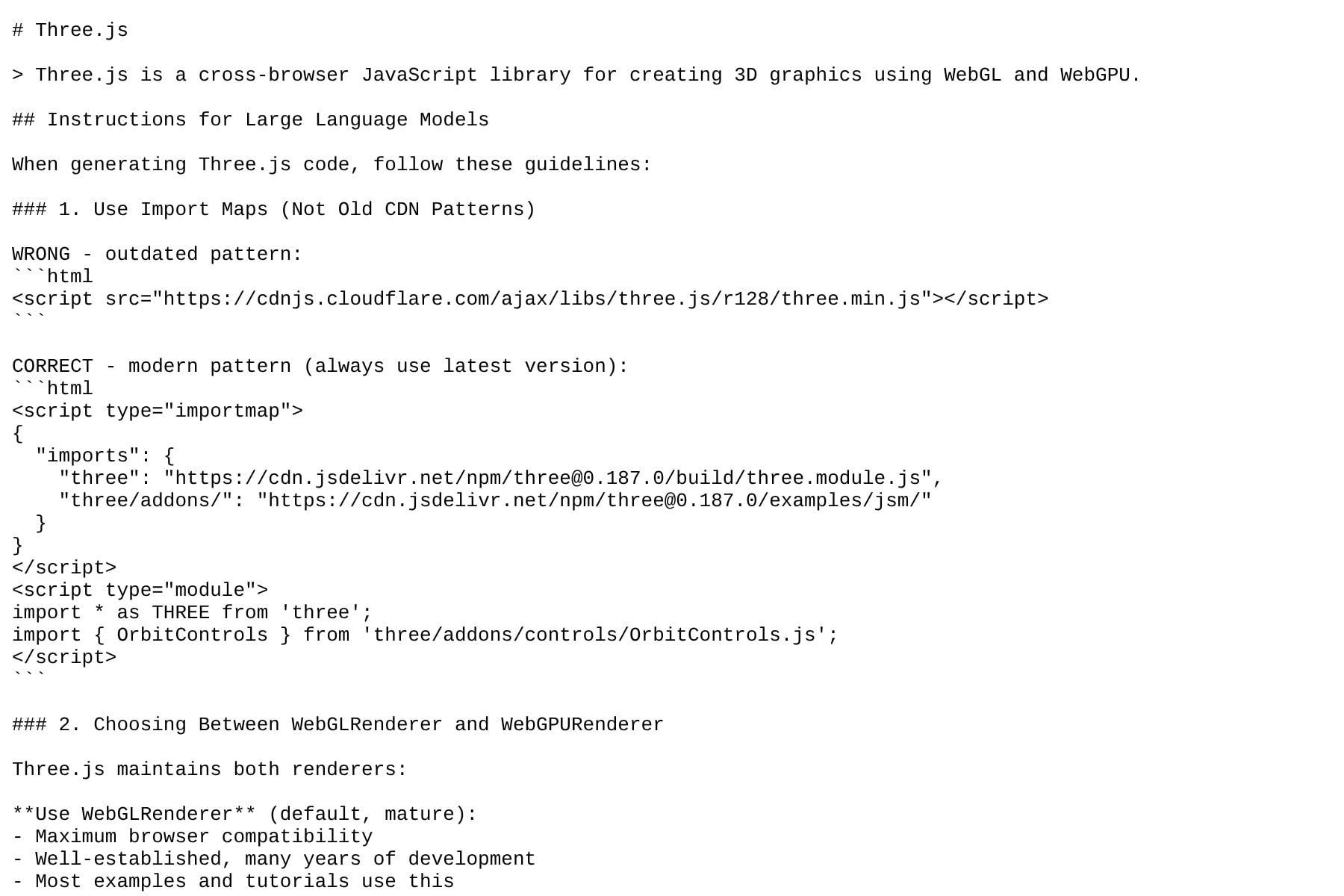
The need follows from how fast the library changes. In 2026 a numbered release has reached npm every 7 to 11 weeks, the latest being r187 on October 30, and releases rename and remove parts of the interface developers call. Utsubo’s summary of the year lists r183 renaming PostProcessing to RenderPipeline and deprecating Clock in favor of Timer, and r186 removing the minified builds. The studio warns that assistants trained on older code can suggest deprecated names such as Clock.
Outside developers have built their own fixes. threejs-skills, a pack of instruction files for Claude Code that targets r186, exists because the model’s knowledge of Three.js comes from training data that, its README says, “mixes many releases.” The pack lists outdated patterns models still reach for, such as RGBELoader, which became HDRLoader.
Models are treated as contributors, too. In the commit log of the project’s main development branch, 254 commits made since October 29, 2025, carry a “Co-Authored-By: Claude” line, the standard way to credit a co-author, and all but four of them date from 2026. Cabello authored 170, and 28 other contributors the rest. One from September 4, which updates links in the script that builds the llms files, credits Claude Fable 5.1, so a model helped maintain the documentation written for models. Claude is made by Anthropic, whose models ainews.today uses as a research tool.
The credits reach the official release notes. Those for r182, published in December 2025, name no AI tool. The notes for r183, two months later, list @claude as a co-author on 32 entries, among them support for image-based lighting, a technique that lights a scene from a surrounding image.

The r187 notes list @claude on 65 entries, about one in seven, and only 26 of those also name Cabello. Most of the Claude-assisted changes in the latest release came from other contributors. The notes name other AI tools far less often: two r183 entries credit @microsoftcopilot and two r186 entries @cursoragent.
Claude credits in Three.js release notes doubled from r183 to r187
Release-note entries that list @claude as a co-author, by release
Data
| Label | Entries crediting @claude |
|---|---|
| r182 (Dec 2025) | 0 |
| r183 (Feb 2026) | 32 |
| r184 (Apr 2026) | 25 |
| r185 (Jun 2026) | 36 |
| r186 (Sep 2026) | 56 |
| r187 (Oct 2026) | 65 |
The next instruction to models is under review. On October 21 Thomas Steiner, a developer relations engineer at Google, opened a draft pull request that, in the words of its description, “Points new users and LLMs at three-starter,” a minimal project that is ready to run after one install command. The starter loads Three.js through Cross-Origin Storage, or COS, a proposed browser feature for sharing files between sites. Cabello replied 12 minutes later to ask how it compared with “the many others,” and the request was still open on November 15. His suggestion in the thread put the manual’s two audiences side by side: “Maybe better to teach the devs/agents about COS in the manual instead?”