How ElevenLabs is turning its voice technology into enterprise software
Listeners rank its newest voice model first, by a narrow margin and at four times a rival’s price. The company now sells agents tuned on customers’ data.

Summary
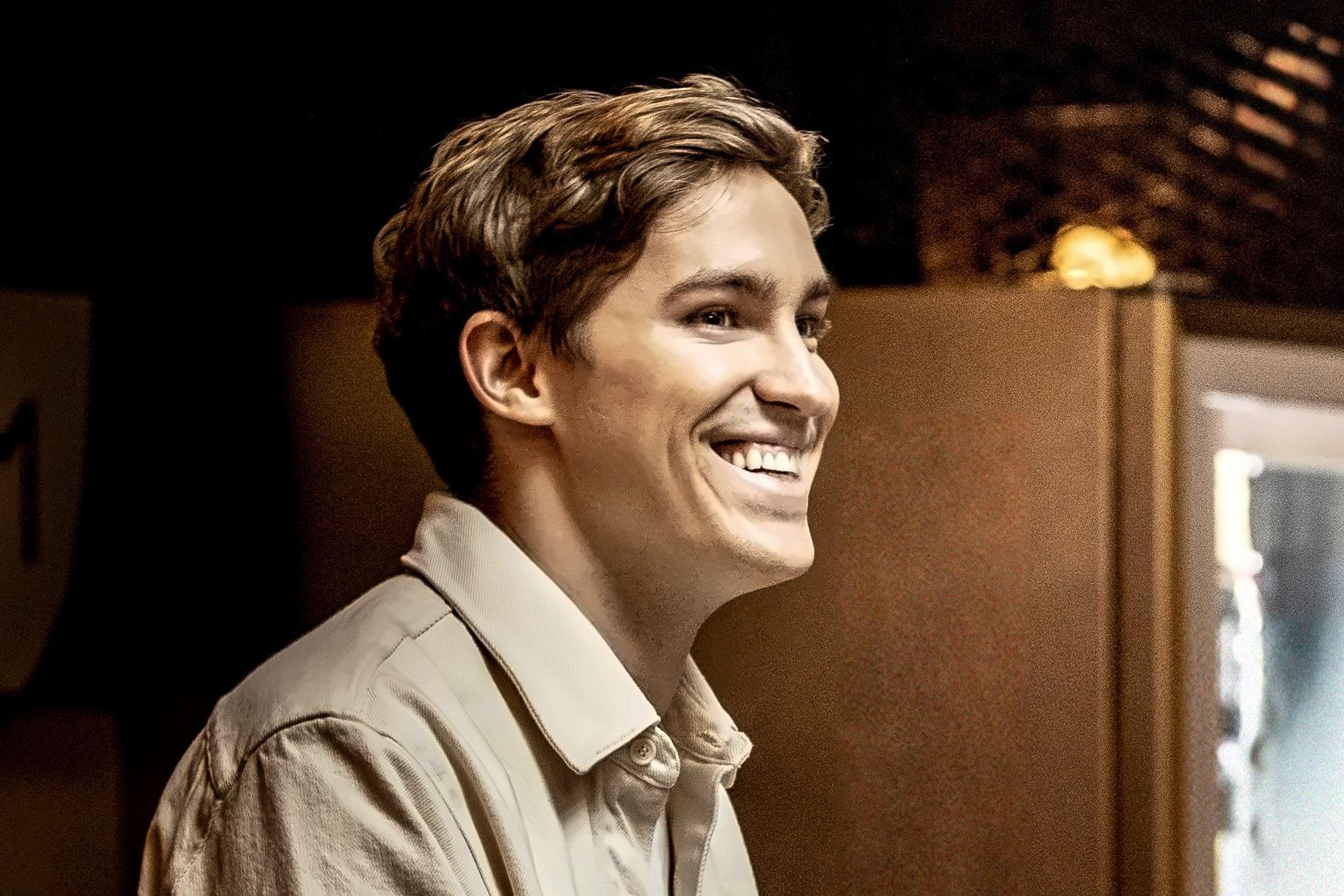

Mati Staniszewski, the chief executive and co-founder of ElevenLabs, ended his keynote at the company’s Summit in New York on November 11 on the subject of moats, the defenses that keep competitors from copying a business. “People are understandably concerned that AI could centralize and homogenize everything. That businesses won’t be able to protect their moats,” he said, according to the company’s account of the Summit. His answer was a set of models and products meant to help customers “extend your advantage.”
ElevenLabs entered the market with far less. Its public beta in January 2023 offered English text-to-speech, software that reads written text aloud in a synthetic voice, and voice cloning, which copies a person’s voice from a recording. The company says it raised its first round in 2022 at a $9 million valuation. Its announcement of an employee share sale on September 30 put the valuation at $22 billion and enterprise customers at 55% of revenue.
The Summit showed where ElevenLabs now places its defense. On Artificial Analysis’ independent ranking of synthetic voices, its Eleven v4 model is first, but the 40-point gap to the nearest rival on the Elo scale corresponds to winning about 56 of 100 listener comparisons, and v4 costs four times as much. In transcription the company’s newest model ranks second. The announcements in New York point to a defense that is harder for a customer to walk away from: agents sold as one integrated system, models tuned on each customer’s own conversations, a partner sales channel, and licensed music and voice rights.
By 2025, sound quality was no longer the bottleneck
The early models had basic problems. When ElevenLabs added French, German, Hindi, Italian, Polish, Portuguese and Spanish with Multilingual v1 on April 27, 2023, the announcement warned that “some numbers and symbols may currently be pronounced incorrectly” and asked users to spell them out.
By mid-2025 the company described a different limit. Introducing Eleven v3 in alpha on June 3, 2025, with more than 70 languages, a multi-speaker dialogue mode and audio tags, inline instructions that set tone or add a sigh or a whisper, co-founders Piotr Dabkowski and Staniszewski wrote that after Multilingual v2 “the consistent limitation wasn’t sound quality — it was expressiveness.” The same post told customers with real-time and conversational uses to stay on older, faster models.
ElevenLabs promoted the release on X two days later as “the most expressive Text to Speech model ever,” at 80% off for June.
The next releases worked on reliability and speed. When v3 left alpha on February 2, ElevenLabs said in its general-availability post that errors in reading numbers, symbols and notation fell from 15.3% to 4.9% on an internal benchmark of 27 categories in 8 languages, the same weakness its 2023 announcement had flagged. Eleven v4, launched on September 28 as “our most emotive text-to-speech model yet,” covers more than 90 languages, and its Turbo variant targets “low-latency use cases like agents,” software that handles tasks such as phone calls on its own. The company puts Turbo’s median time to first speech at about 150 milliseconds and says an instant clone needs 10 seconds of audio.
Listeners rank Eleven v4 first, by a narrow margin
Independent testing supports the company’s main claim. The v4 post says the model is “Ranked #1 by Artificial Analysis,” and the evaluator’s Provider Voice Arena leaderboard, which rates models from users’ votes between pairs of voices, showed Eleven v4 first on November 15 with an Elo score of 1,340 and v4 Turbo second at 1,339. Alibaba’s Qwen-Audio-3.1-TTS-Plus followed at 1,300 and Cartesia’s Sonic 3.6 at 1,294. The 95% intervals of the two ElevenLabs models do not overlap with those of any rival.
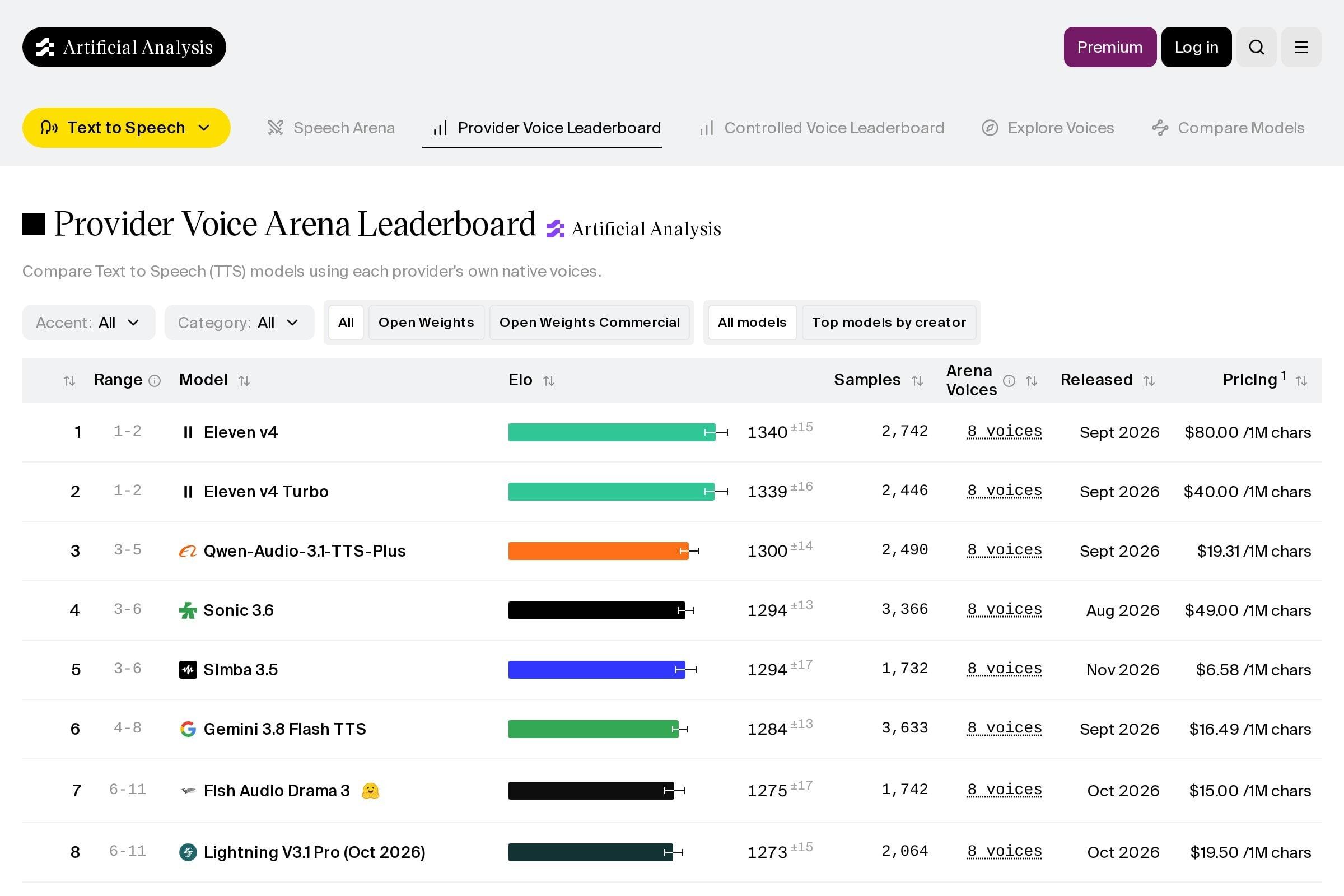
The size of that lead is modest. On the standard Elo scale the evaluator uses, a 40-point gap means listeners would prefer Eleven v4 to the third-placed model in about 56 of 100 comparisons. ElevenLabs’ own blind tests, reported in the v4 post, put the preference at about 75% against Cartesia Sonic 3.6, Inworld TTS-2 and two Google Gemini TTS models, with graders judging expressiveness and naturalness and ties counted as half. Those results have not been independently verified. ainews.today uses ElevenLabs’ text-to-speech for the audio versions of its articles and its image tools for cover illustrations.
The lead also carries a price. The leaderboard lists Eleven v4 at $80 per million characters, about four times the $19.31 of the Qwen model and 12 times the $6.58 of Speechify’s Simba 3.5, which sits 46 points below it.
In transcription, the reverse task of turning speech into text, ElevenLabs does not lead. On Artificial Analysis’ AA-WER index, Alibaba’s Fun-Realtime-ASR-preview had the lowest word error rate, the share of words transcribed wrongly, at 1.7% on November 15. Scribe v3, which ElevenLabs launched in early November and calls its most accurate transcription model, was second at 1.9%, with models from Microsoft, Zoom and Mistral within 0.2 points of it.
ElevenLabs’ newest transcription model ranks second, behind Alibaba’s
Word error rate on Artificial Analysis AA-WER v2, %, lower is better
Data
| Label | Word error rate |
|---|---|
| Fun-Realtime-ASR-preview (Alibaba) | 1.7% |
| Scribe v3 (ElevenLabs) | 1.9% |
| MAI-Transcribe-2 (Microsoft) | 2% |
| Zoom Scribe V2.1 Pro (Zoom) | 2.1% |
| Voxtral Small Transcribe 3 (Mistral) | 2.1% |
| Grok Voice Transcribe 2.0 (SpaceXAI) | 2.3% |
| Gemini 3.5 Transcribe (Google) | 2.6% |
| Universal-3.5 Pro (AssemblyAI) | 3% |
| GPT Transcribe (OpenAI) | 3.3% |
The Summit pitch was integration and customer data
ElevenLabs’ own documents now argue from the system around the voice. The v4 post sets its approach against rivals that “stitch together models and software from different vendors,” and says ElevenLabs optimized v4 Turbo and its ElevenAgents platform “together as one system.” At the Summit, Staniszewski said conversational agents will become “critical infrastructure for every enterprise, as essential as cloud or payments.”
The most consequential announcement concerns customer data. In the coming months, the company said, it will help businesses fine-tune, or further train, certain open-source language models and its own voice models on data from their live deployments, working with ElevenLabs researchers toward metrics such as customer satisfaction. Staniszewski compared this to each company having its own reinforcement-learning stack, a setup that improves models from feedback on outcomes. That arrangement points to a moat made of the customer’s own calls, refined into models that run on ElevenLabs’ platform.
Other announcements make the voice one component among several. A previewed Interaction Engine handles turn-taking and interruptions and picks a language model for each step of a conversation, a cheaper one for triage and a frontier model, the most capable class, for harder tasks. Memory will let agents recall returning customers, and Routines will run follow-up work such as writing to a customer-records system. ElevenLabs named Yahoo, Westgate and KPN as ElevenAgents users.
Distribution is the second new layer. The company counts more than 550 partners in 44 countries, including Google Cloud, IBM, Deloitte and Genesys, and announced an alliance with McKinsey and its QuantumBlack unit. It also said it is adding 15 megawatts of Nvidia Vera Rubin computing capacity and will build, with Nvidia, an on-premises voice agent that schedules appointments on Poland’s national e-Health platform for patients who only have landlines.
The workplace app carries the same logic to employees. ElevenAI, opened for early access at the Summit, takes meeting notes and handles dictation on Scribe v3. TechCrunch’s report on the app on November 13 placed it in a category where Fireflies, Wispr Flow and Granola have released competing features, and read it as a way for enterprise teams to skip buying separate notetaker licenses.
The case that the voice is still the product
ElevenLabs argues that the integration depends on the voice. The Summit post says the company started with voice and built what it calls the industry’s leading models for natural conversation. The v4 post describes a market in which buyers had to trade expression for speed: “Many have opted for proficient, but monotone, agents that can seem robotic to a flustered customer just looking to resolve their issue.”
The independent ranking gives that argument its best evidence. Both v4 models sit above every rival despite the higher list price, and the business has grown with them. ElevenLabs closed 2025 with more than $330 million in annual recurring revenue, it said in its Series D announcement in February, and the tender announcement says its technology is in daily use at five of the world’s ten largest technology companies.
Investors have priced the company as a leader. The $500 million Series D, led by Sequoia Capital, valued ElevenLabs at $11 billion, up from $3.3 billion at its Series C in January 2025. The September tender, led by Wellington and T. Rowe Price, doubled that figure. A tender is a sale of existing shares by employees, and it brings the company no new capital.
ElevenLabs’ valuation doubled in the seven months to September 2026
Valuation announced by the company, $ billion
Data
| Label | Valuation |
|---|---|
| Jan 2025 (Series C) | $3.3B |
| Feb 2026 (Series D) | $11B |
| Sep 2026 (tender) | $22B |
The agent layer is contested too. OpenAI launched Businesses in ChatGPT in beta on November 10, the day before the Summit, letting companies claim profiles and, in the US, run their own Business Agents. Taken together, the public evidence supports a measurable lead for ElevenLabs in synthetic voices, held at a premium price, and none in transcription.
Licensed rights are the other defense, and the least settled
Music shows what licensing can buy. Eleven Music launched on August 5, 2025 with deals from the publisher Kobalt and from Merlin, which represents independent labels. Music Business Worldwide reported a roughly 50/50 royalty split between publishing and recordings, a most-favored-nation clause that upgrades Kobalt if a recorded-music rights holder later gets better terms, and a Pro tier to be trained on cleared catalog. Suno and Udio, the services Eleven Music competes with, face suits from major labels and publishers alleging “copyright infringement on a massive scale.”
The music business has grown on that base. Users have created more than 25 million tracks with its models, ElevenLabs said, according to TechCrunch’s November 5 report on a deal that lets them publish directly to SoundCloud. The report also noted a Spotify partnership for AI-narrated audiobooks.
The legal position on voices is less settled. In Vacker v. ElevenLabs, filed in federal court in Delaware on August 29, 2024, two audiobook narrators and the authors and publisher they worked with challenged the company’s “Bella” and “Adam” voices, which they said were cloned from the narrators, as the plaintiffs’ brief sets out. The case closed on November 6, 2025, with all claims dismissed with prejudice and no ruling on the merits.
A second suit reaches further. Seven Illinois residents, among them the broadcast journalist Carol Marin and the Pulitzer-winning podcast host Yohance Lacour, sued ElevenLabs in federal court in Chicago on May 11 under the state’s Biometric Information Privacy Act. Their complaint alleges the company extracted voiceprints from their recordings without the written notice and release the law requires, and that it “chose speed and scale over compliance.” ElevenLabs says creators in its Voice Library had earned more than $22 million by May, and the Summit post says ElevenAI has notice and consent mechanisms built in.
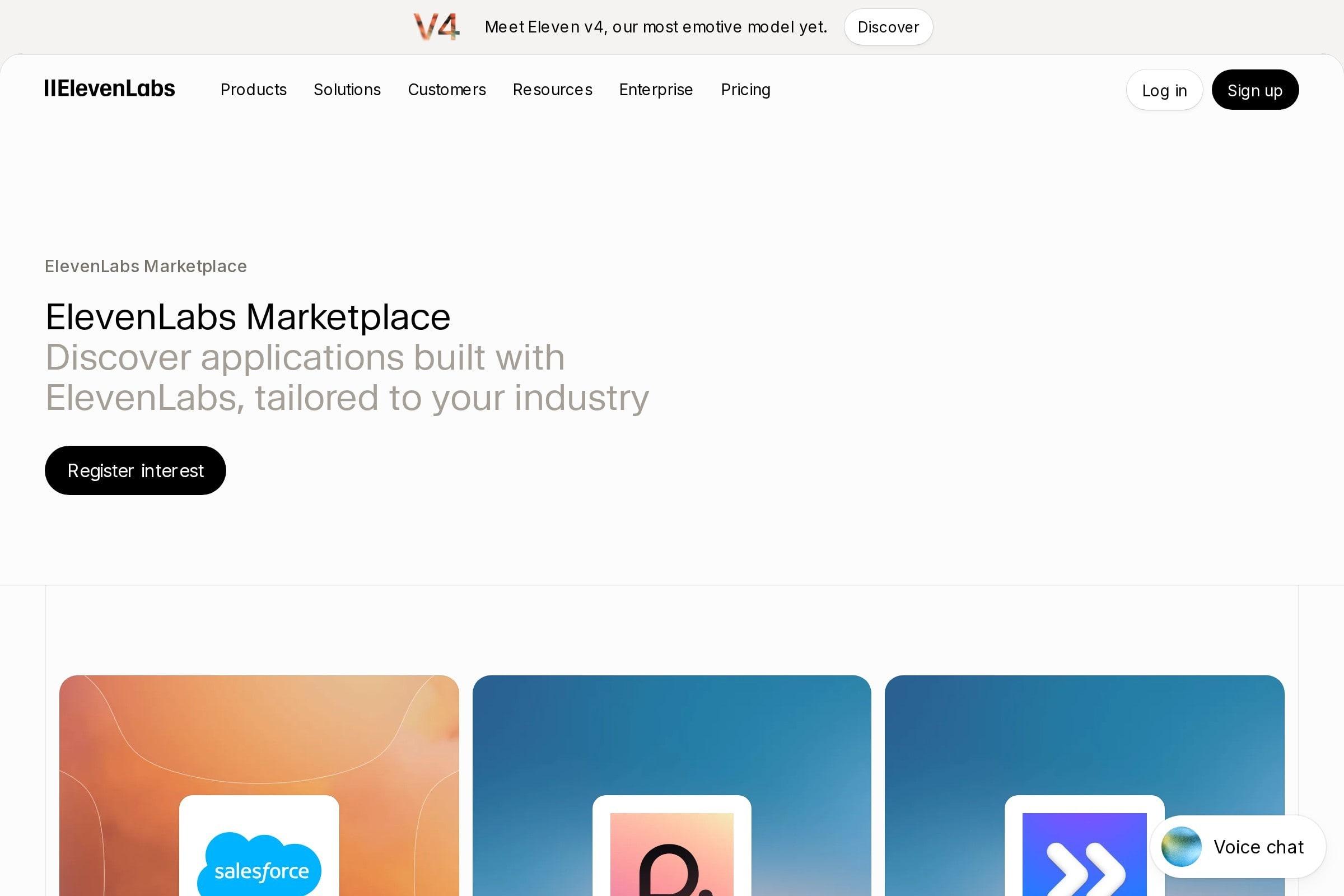
The Summit post also set a date for the partner channel. Starting in 2027, businesses will be able to buy partners’ industry agents through the new ElevenLabs Marketplace “using their existing ElevenLabs commitment,” so money already pledged to ElevenLabs will pay for software it did not build.